
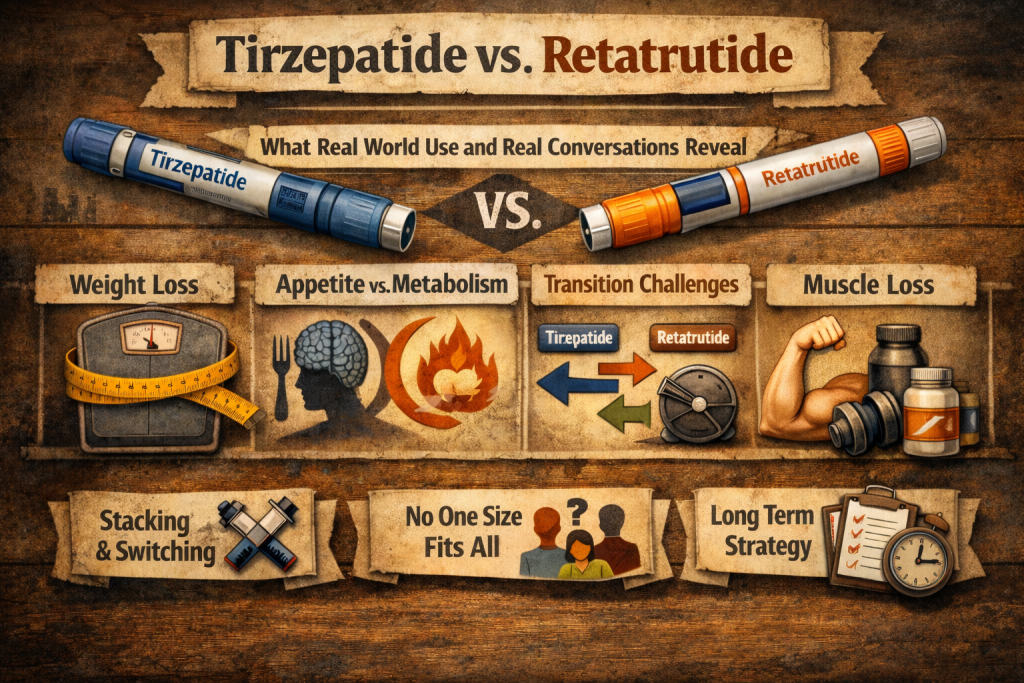
What Real World Use and Real Conversations Reveal
This article reflects a synthesis of publicly shared experiences and discussions, combined with my own firsthand experience and a review of publicly available research. It is intended for educational purposes only.
This piece grew out of a long forum discussion that spiraled into hundreds of replies. Instead of letting those insights get buried in a comment thread, I wanted to pull the most useful ideas into one place and lay them out in a way that actually makes sense when you read it start to finish.
Before going any further, a quick disclosure.
I spent a period of time closely involved with a GLP focused telemedicine platform, where I hosted educational webinars and coached patients as part of a partnership arrangement that included treatment access. During that time, I also used Tirzepatide personally and lost a significant amount of weight with it, and later transitioned off successfully using a structured framework I developed over time. That process is its own topic and outside the scope of this article. I am no longer involved with that platform and I am not affiliated with any prescribing organization, pharmacy, or peptide vendor. I am not a physician, and nothing in this article should be interpreted as medical advice.
What follows reflects firsthand experience, publicly available data, and recurring patterns that emerge when enough people start comparing notes honestly.
Why This Conversation Matters
Most comparisons between Tirzepatide and Retatrutide focus on surface level outcomes. Scale weight. Appetite suppression. Which compound is stronger.
What often gets ignored is context.
As Jamie pointed out during the discussion, outcomes alone do not explain why these compounds behave so differently from person to person. Clinics often prioritize speed, visible results, and retention. From a business standpoint, that model works extremely well. From a long term patient perspective, it does not always align with sustainability.
Those two goals are related, but they are not the same.
Those two goals are not the same thing.
Appetite Suppression vs. Metabolic Signaling
From both personal experience and working with many individuals, Tirzepatide consistently produces stronger appetite suppression and quieter food noise. This is why weight often comes off quickly, particularly for people with a significant amount to lose.
Retatrutide tends to feel different.
As several people, including Dania F., observed, Retatrutide is often experienced as more metabolic in nature. People describe increased energy expenditure rather than strong appetite control. That perception aligns with its glucagon receptor activity, which can increase thermogenesis and energy utilization.
The problem is that appetite suppression matters more than most people expect.
Multiple participants, including Doreen T. and Deirdre S., described significant hunger rebound when switching from Tirzepatide to Retatrutide. In some cases, the rebound was strong enough to stall progress or reverse it entirely.
That pattern is not rare.
Why Transitions Are Harder Than Starting Fresh
One of the more technically insightful points came from TJ., who highlighted a critical issue that is rarely discussed. People transitioning from Tirzepatide to Retatrutide are not starting from a neutral baseline.
By the time someone switches compounds, they have often already lost a substantial amount of weight, altered receptor sensitivity, reduced energy reserves, and accumulated metabolic adaptations that make further fat loss harder regardless of the compound being used.
This helps explain why early clinical data from first time Retatrutide users does not always translate cleanly to people switching after extended Tirzepatide use.
The compound did not fail.
The physiology changed.
Muscle Loss Is Not a Moral Failure
Another theme that surfaced repeatedly was muscle loss, often framed with frustration or shame.
Rapid weight loss includes lean tissue loss. That is true regardless of which GLP based tool someone uses. There is no option available today that allows someone to lose sixty or seventy pounds quickly without sacrificing a meaningful amount of muscle.
That is not failure.
That is biology.
What surprises many people is that slowing weight loss enough to preserve muscle is often harder than losing weight itself. Strong appetite suppression makes rapid loss easy and controlled loss difficult.
This is why resistance training, adequate protein intake, and intentional rebuilding phases matter far more than debating which compound is superior.
Stacking, Switching, and Signal Noise
The discussion also touched on stacking compounds, particularly combinations involving Tirzepatide, Retatrutide, or Cagrilintide.
While some individuals report short term benefits, stacking often introduces more confusion than clarity. Overlapping mechanisms blur signaling pathways, making it harder to identify what is helping and what is driving side effects.
Several contributors, including Simon K. and Allan J., raised concerns about nervous system activation, elevated resting heart rate, and disrupted recovery, particularly with retatrutide. These experiences are not universal, but they reinforce the importance of monitoring and context.
Absolutes in either direction rarely hold up once you zoom out.
One Size Does Not Fit All
A recurring theme across the entire discussion was simple but important: there is no universally “best” GLP tool.
- Tirzepatide tends to be more effective for significant weight loss and appetite control.
- Retatrutide may play a role later in the journey for slower loss or maintenance-adjacent phases.
- Switching compounds does not automatically solve stalls.
- Stacking compounds does not replace planning.
As Allan C. summarized well, these tools require context, monitoring, and an exit strategy. Without that, people often end up chasing compounds instead of building sustainability.
Final Perspective
Most long term problems people encounter with GLP based tools are not caused by the compounds themselves. They come from poor transition planning, unrealistic expectations, and a lack of strategy around maintenance and muscle preservation.
Weight loss is the visible phase.
Maintenance is the skill phase.
If you are thinking through how to taper, transition, or maintain results without undoing your progress, that process benefits far more from structured planning than from novelty or constant switching.
Private Coaching (Optional)
If you have a specific educational question related to this topic, I occasionally answer one per person via email. I cannot provide medical advice, but I am happy to offer general context and perspective. If that would be helpful, you can email me here.