
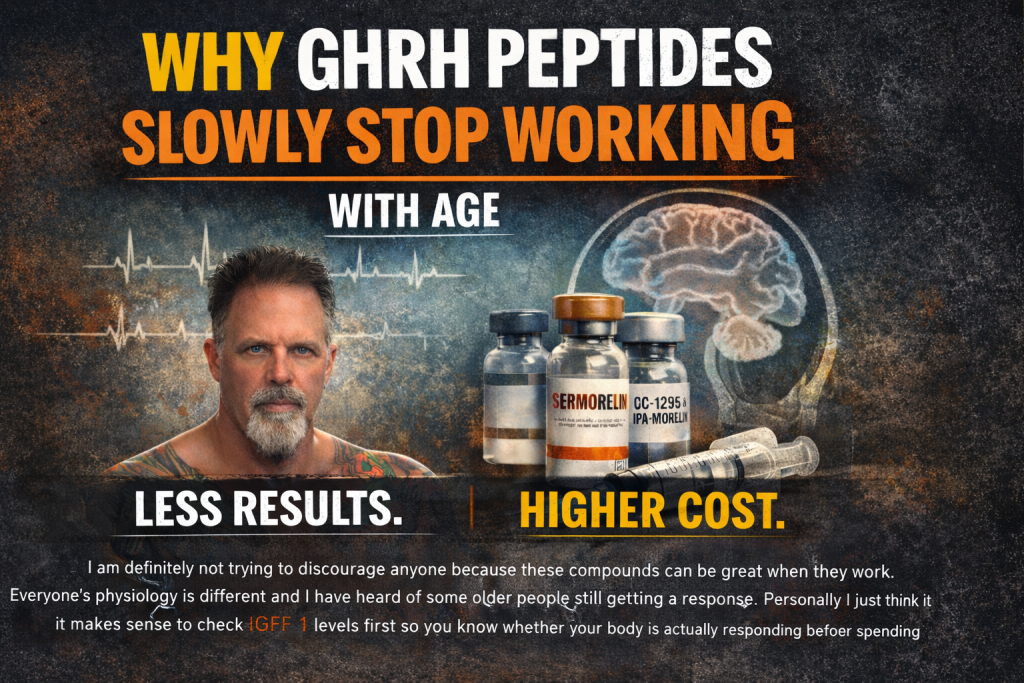
I learned this the hard way. It cost me a lot of money and a lot of time.
Like a lot of people getting into peptides, I started with the classic growth hormone secretagogues. Sermorelin, CJC, Ipamorelin. On paper they sound perfect. Stimulate your body to make its own growth hormone. Natural. Physiological. All the right buzzwords.
I started testing them when I was 55. I am 57 now.
My first run was Sermorelin. Complete failure. Not maybe it worked a little. I verified it with IGF 1 blood tests. No meaningful change at all.
Then I moved to Tesamorelin and CJC combinations. Those were marginally better. Some people do see visceral fat reduction from Tesamorelin and there is real data behind that. But once I started digging deeper, the reason became pretty obvious.
Your ability to release growth hormone declines with age. A lot.
Even in a good scenario you might stimulate something like three to four IU worth of growth hormone. The ironic part is you might spend more money trying to stimulate those three or four IU than you would just injecting four or five IU of generic HGH directly.
In other words, the ceiling is built into your biology.
When you are younger, the pituitary still has plenty of capacity and the signal works. As you age, the signal can still be strong but the output is weak because the system itself is declining.
That was exactly what I saw in my own bloodwork. The peptides were doing their job. My body just did not have much growth hormone left to release.
I am definitely not trying to discourage anyone because these compounds can be great when they work. Everyone’s physiology is different and I have heard of some older people still getting a response. Personally I just think it makes sense to check IGF 1 levels first so you know whether your body is actually responding before spending a lot of money.
So the hard truth is this. GHRH peptides like Sermorelin, CJC, and Ipamorelin can work very well when you are younger. But the older you get, the more they turn into an expensive experiment with diminishing returns.
I wish I had understood that earlier. It would have saved me a lot of money and a lot of time chasing something my biology was no longer capable of producing.
One last thing that almost nobody talks about is safety. Anything that raises growth hormone or IGF 1 should be treated with respect. If you are experimenting with secretagogues or HGH, basic screening matters.
At a minimum I think people should periodically check IGF 1 levels so they know where they actually are. It is also smart to stay current on age appropriate cancer screenings like PSA for prostate, colon screening, and routine blood panels. Growth signaling pathways can accelerate existing problems if something is already developing.
None of this means these compounds are inherently dangerous. It just means if you are going to push growth pathways, it makes sense to keep an eye on the systems those pathways affect.
Most people obsess over the peptides. Very few people pay attention to the monitoring. In my opinion the monitoring is the more important part.