Investigative Report · Tested By Tim
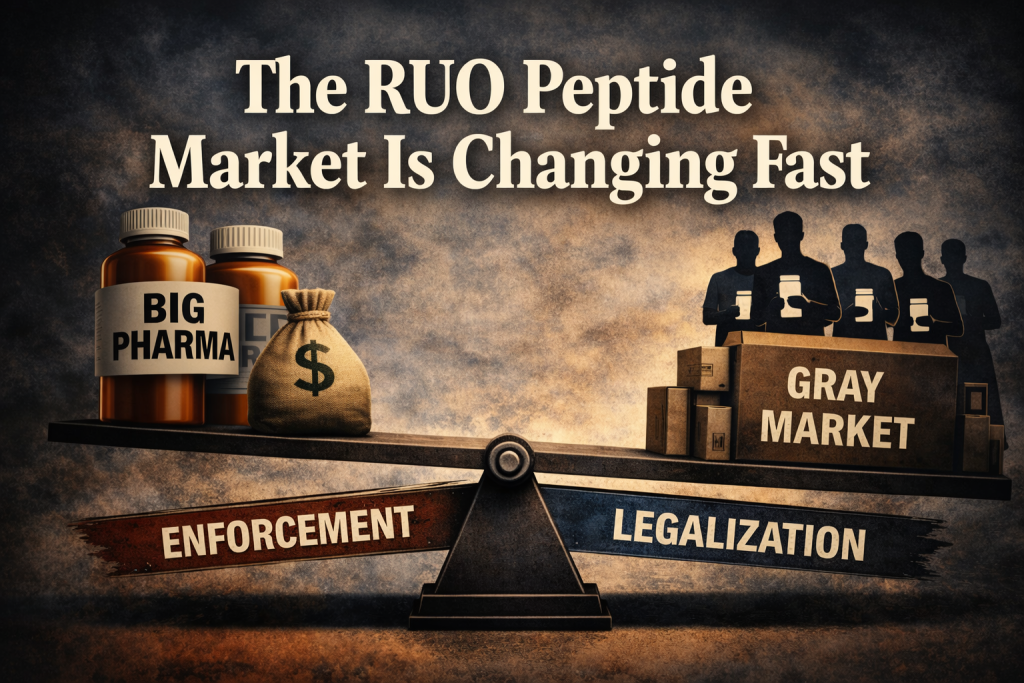
Peptide Sciences, one of the largest gray-market research peptide vendors in the U.S., shut its doors on March 6, 2026 — the most visible casualty yet of a coordinated regulatory, legal, and corporate offensive that has been dismantling the research peptide ecosystem since late 2023.
Chapter 1
A “Voluntary” Exit That Wasn’t Really Voluntary
On March 6, 2026, visitors to peptidesciences.com found a terse message. The word “voluntarily” is doing heavy lifting.
“After careful consideration, Peptide Sciences has made the decision to voluntarily shut down operations and discontinue the sale of our research products.” — Site Message, March 6, 2026
The Facebook page was deleted. The site returned a 403 error within hours. A promo code had still been working on March 5.
Four Converging Pressures
The evidence points to at least four forces that made continued operation untenable — each compounding the others in a feedback loop that left no viable exit except closure:
- FDA Warning Letter (2023): Received for making therapeutic claims about BPC-157 and TB-500, crossing the line from “research chemical” to unlicensed drug marketing.
- Catastrophic Quality Failures: Finnrick Analytics rated their retatrutide an “E (Bad)” — the lowest confidence rating — and flagged one sample as outright counterfeit. Their tirzepatide scored a middling “C,” with 5mg vials containing only 3.89–4.29mg of actual product — a 14–22% shortfall.
- GLP-1 Catalog Pullback: Already began pulling semaglutide, tirzepatide, and retatrutide in early 2026, citing “alignment with evolving industry compliance guidance.”
- Hostile Legal Environment: Eli Lilly’s ITC exclusion orders, the SAFE Drugs Act, and 50+ FDA warning letters in September 2025 alone made the business model increasingly precarious.
“The old model — anonymous research vendors supplying molecules that ultimately end up in human experimentation — may be becoming harder to sustain.” — Dr. Steven Murphy, Longevity Physician
Chapter 2
A Regulatory Offensive Three Years in the Making
The Peptide Sciences closure is the latest domino in a systematic enforcement campaign that began accelerating in September 2023. The September 2025 wave alone accounted for 50+ warning letters.
Enforcement Timeline
| Date | Event | Severity |
|---|---|---|
| Sep 2023 | FDA moves 19 peptides to Category 2. BPC-157, TB-500, CJC-1295, Ipamorelin, AOD-9604, Thymosin Alpha-1, and 13 others banned from compounding. | Critical |
| Dec 2024 | Warning letters issued to SwissChems, Prime Peptides, Xcel, Summit for selling semaglutide, tirzepatide, and retatrutide as unapproved drugs. PCAC votes against ipamorelin, MK-677, CJC-1295, AOD-9604. | High |
| Feb 2025 | FDA declares semaglutide shortage “resolved,” eliminating the legal basis for compounding pharmacies to prepare copies of Ozempic and Wegovy. | High |
| Jun 2025 | Amino Asylum warehouse raided. Federal agents seize inventory. Products reportedly spiked with undisclosed compounds. | Critical |
| Sep 2025 | 50+ warning letters in a single wave with confirmed DOJ involvement — a clear signal that criminal prosecution was on the table. | Critical |
| Nov 2025 | Alabama obtains first state-level temporary restraining order against GLP-1 distributors. | High |
| Jan 2026 | Strive Compounding Pharmacy v. Eli Lilly and Novo Nordisk antitrust lawsuit filed. | Medium |
| Mar 6, 2026 | Peptide Sciences closes. Site returns 403 error. Facebook page deleted. | Critical |
Two legal precedents have been especially consequential. In Tailor Made Compounding, a $1.79M forfeiture established that “for research only” labels are legally meaningless when products are sold with syringes, bacteriostatic water, and dosing guides. In All American Peptide, a $3M+ forfeiture confirmed that the FDA’s Intended Use Doctrine evaluates total commercial context — not disclaimers. The agency is now using AI to scrape vendor websites for hidden dosing information.
Eli Lilly also secured a General Exclusion Order from the International Trade Commission prohibiting all importation of tirzepatide products infringing its trademark — a blanket ban that applies to every importer, not just named defendants.
Chapter 3
Big Pharma’s $50 Billion Defense
The community’s dominant theory — that Novo Nordisk and Eli Lilly are driving the crackdown — is not speculation. It is extensively documented in lobbying disclosures, court filings, and SEC reports.
Novo Nordisk cut its 2025 sales guidance three times, explicitly citing compounded GLP-1s as the cause. Wegovy U.S. sales shrank 2% in Q4 2025. The companies slashed their own prices only after compounding competition emerged — not before:
| Product | Monthly Cost |
|---|---|
| Branded Ozempic/Wegovy | $1,160 |
| Branded Zepbound (post-competition) | $346 |
| Trump Admin Deal Price | $299 |
| Compounded Semaglutide | $199 |
| Chinese Group Buy (tirzepatide kit) | $100 |
Of Novo Nordisk’s 77 lobbyists in 2023, 54 previously held government jobs — a textbook revolving door. Both companies hired Ballard Partners, connected to Trump administration officials. Combined pharma industry lobbying hit $451.8M in 2025. Ballard Partners billed $20M in Q2 2025 alone.
A January 2026 antitrust lawsuit (Strive Compounding Pharmacy v. Eli Lilly and Novo Nordisk) alleges the companies entered exclusive agreements with telehealth platforms (Teladoc, Ro, LifeMD, WeightWatchers) that barred those platforms from working with compounders, interfered with payment processors, and “disparaged compounded GLP-1s by falsely grouping them with counterfeit drugs.”
“The companies had effectively re-established their monopolies over the GLP-1 market.” — BMO Capital Markets analysts
Chapter 4
The Vendor Landscape: Who’s Gone, Who’s Still Standing
| Vendor | Status | Details |
|---|---|---|
| Peptide Sciences | Closed | “Voluntary” shutdown Mar 6, 2026. Quality failures, FDA warning letter. |
| Amino Asylum | Raided | Federal warehouse raid Jun 2025. Possible rebrand as “SomaChems.” |
| Science.bio | Closed | Jan 2026. Cited operations becoming “more difficult and more expensive.” |
| Triggered Brand | Closed | ITC cease-and-desist. Settled with Connecticut AG. |
| Rats Army | Closed | Early casualty Mar 2022. |
| SwissChems | Warning | FDA warning letter Dec 2024. Still operating. |
| Limitless Life Nootropics | Active | Frequently recommended in community forums. |
| Core Peptides | Active | Budget option. Some fulfillment complaints reported. |
| Biotech Peptides | Active | 87+ peptide catalog. San Diego based. No reported enforcement actions. |
| Pure Rawz | Active | Expanded from SARMs market. Accepts crypto and Zelle. |
Payment processor restrictions have become an existential threat. PayPal, Stripe, and Square all refuse peptide merchants, forcing vendors onto high-risk processors charging 10%+ fees with rolling reserves.
Surviving vendors have begun a coordinated retreat from GLP-1 products, removing semaglutide, tirzepatide, and retatrutide from catalogs to avoid becoming enforcement targets.
Chapter 5
Community Adaptation: Telegram, Group Buys, and Chinese Direct Sourcing
The biohacker and longevity communities are reorganizing around three primary strategies:
1. Encrypted Group Messaging
Telegram groups like “Stairway to Gray,” “Peptide Research Group,” and PepChat now function as the de facto marketplace. Discord servers fill a similar role, with vendor-specific channels and real-time testing discussions. Risk level: Medium.
2. Chinese Direct Sourcing
Buyers pool funds on Telegram and WhatsApp to purchase directly from Chinese API producers — $100 for a 10-vial tirzepatide kit versus $600+ from U.S. vendors. Chinese peptide imports to the U.S. doubled to $328M in 2025. Risks include no regulatory oversight, inconsistent quality, scam potential, and no dosing verification. Risk level: High.
3. Waiting for Re-legalization
Multiple practitioners are holding patients until the RFK Jr. reclassification becomes official, advising against gray-market sourcing when legitimate pharmacy access may be weeks away. Risk level: Low.
Finnrick Analytics and Janoshik have become critical infrastructure — trusted arbiters of quality in a market without institutional guardrails. In a market where the FDA’s “for research only” label has been stripped of legal meaning, third-party testing is the only quality signal buyers have left.
Chapter 6
The RFK Wildcard: Liberation or Irrelevance?
On February 27, 2026, HHS Secretary Robert F. Kennedy Jr. appeared on Joe Rogan Experience #2461 and announced that approximately 14 of 19 Category 2 peptides would be moved back to Category 1, restoring legal compounding access. He called the Category 2 designations “illegal,” arguing the FDA acted without required safety signals.
“We created the gray market.”— RFK Jr., Joe Rogan Experience #2461, Feb 27, 2026
Peptide Reclassification Outlook
| Peptide | Use | Outlook |
|---|---|---|
| BPC-157 | Tissue repair, gut healing | Likely Restored |
| TB-500 | Muscle recovery | Likely Restored |
| Thymosin Alpha-1 | Immune modulation | Likely Restored |
| CJC-1295 | GH secretagogue | Likely Restored |
| Ipamorelin | GH secretagogue | Likely Restored |
| AOD-9604 | Fat metabolism | Likely Restored |
| Selanк / Semax | Cognitive/anxiolytic | Likely Restored |
| GHK-Cu / Epithalon | Anti-aging/wound healing | Likely Restored |
| LL-37 | Antimicrobial | Uncertain |
| Melanotan II / GHRP-2 | Tanning, libido, GH stimulation | Likely Stays Banned |
| Semaglutide / Tirzepatide / Retatrutide | GLP-1 weight loss | Not Included |
This creates a paradox for gray-market vendors: if the reclassification goes through, licensed compounding pharmacies will legally supply BPC-157, TB-500, and other popular peptides under physician prescription — potentially making “research only” vendors redundant for these compounds.
Chapter 7
Follow the Money: The Real Story Behind the Story
For GLP-1 Compounds
Straightforward corporate monopoly defense. Novo Nordisk and Eli Lilly are spending tens of millions annually on lobbying, filing hundreds of lawsuits, securing ITC exclusion orders, and cutting exclusive deals with telehealth platforms — all to protect a combined $50+ billion annual U.S. revenue stream.
For Non-GLP-1 Therapeutic Peptides
More nuanced. No pharma company currently sells BPC-157, TB-500, or Thymosin Alpha-1, so there is no direct revenue to protect. The FDA’s Category 2 restrictions were nominally based on safety concerns — but the enforcement machinery built for GLP-1 protection sweeps these compounds up in the same net. Collateral damage.
For the Gray-Market Business Model
The existential threat is structural. The “for research only” legal fiction has always depended on plausible deniability — and that deniability has collapsed. The FDA is now using AI to scrape vendor websites for hidden dosing information.
Ultimate Beneficiaries
- Novo Nordisk & Eli Lilly: Monopoly protection on the $52.7B GLP-1 market. Compounders threatened to erode their combined revenue by as much as 30%.
- Lobbying Firms: Ballard Partners billed $20M in Q2 2025 alone. Checkmate, a firm opened two days after the 2024 election, went from $910K to $4.4M in revenue.
- Trump Administration: Used the threat of continued enforcement to negotiate branded drug price reductions (Zepbound vials to $299/month).
- Compounding Pharmacies (conditional): If RFK’s reclassification proceeds, they regain a lucrative market for BPC-157, TB-500, and other non-GLP-1 peptides.
The Losers
- 1.5M Americans on compounded GLP-1s: Facing a return to $969–$1,350/month for branded products after access to $99–$299/month compounded versions is eliminated.
- Gray-market vendors: Crushed by enforcement from below and potentially made redundant by re-legalization from above.
- Biohacker/longevity community: Lost access to affordable research compounds while waiting in regulatory limbo.
Conclusion
What Comes Next: Three Scenarios
The research peptide market of 2020–2025 — built on legal gray areas, “not for human consumption” labels, and regulatory inattention — is ending. What replaces it remains uncertain.
The Enforcement Scenario — 35%
More vendor shutdowns, more warning letters, possible criminal prosecutions. GLP-1 compounds permanently locked behind branded pharma monopolies. The gray market shrinks to a rump operation serving niche demand. DOJ involvement, AI-powered website scraping, ITC General Exclusion Orders, and tightening payment processor chokepoints all point this direction.
The Re-legalization Scenario — 30%
RFK’s reclassification goes through. Compounding pharmacies resume preparing BPC-157, TB-500, and other non-GLP-1 peptides under physician supervision. The gray market shrinks naturally as legitimate access returns. Kennedy’s JRE announcement, the administration’s stated intent, and compounding pharmacy lobby support push this direction.
The Fragmentation Scenario — 35%
Supply chains move offshore. Telegram group buys from Chinese manufacturers become the dominant channel. Quality becomes even less predictable. Chinese imports already doubled to $328M in 2025, and community demand remains strong despite enforcement.
Most likely: all three simultaneously. A bifurcated market where GLP-1 compounds remain tightly controlled by pharma incumbents while non-GLP-1 therapeutic peptides gradually return to legitimate compounding channels. The gray market won’t disappear — it will shrink to serve those seeking compounds that never make it back to Category 1, those seeking prices below compounding pharmacy rates, and those in jurisdictions where access remains restricted.
“The Peptide Sciences closure is not the end of the story. It is the end of one chapter and the messy beginning of several more.” — Peptide Market Intelligence, March 7, 2026
Practical Guidance
- For patients: GLP-1 access via compounding is effectively over. Non-GLP-1 peptides may return to legitimate compounding channels if RFK’s reclassification proceeds. Consult a physician before sourcing from any gray-market channel.
- For clinicians: Hold patients until formal FDA reclassification is published in the Federal Register. Kennedy’s podcast announcement has no legal force until formalized.
- For investors: Novo Nordisk and Eli Lilly have largely succeeded in re-establishing GLP-1 monopolies. Watch for antitrust litigation outcomes (Strive v. Lilly/Novo) and RFK reclassification timing.
- For researchers: The independent testing ecosystem (Finnrick Analytics, Janoshik) is now critical infrastructure. Quality verification is the only safeguard in a market without institutional guardrails.
Questions?
If you have a specific educational question related to this topic, I occasionally answer one per person via email. I cannot provide medical advice, but I am happy to offer general context and perspective. If that would be helpful, you can email me here.